Bwindi Impenetrable Forest and Volcanoes National Park are the two best places on Earth to trek mountain gorillas, and they protect the same endangered population, so the choice is about the kind of trek you want, not the gorillas you will see. In short: choose Volcanoes National Park in Rwanda for easy access, comfort, and a short trip at a $1,500 permit, or choose Bwindi Impenetrable Forest in Uganda for a lower $800 permit, more gorilla families, and a wilder rainforest adventure. Together the two parks shelter a large share of the roughly 1,000 mountain gorillas left in the wild (IUCN). This guide compares them park to park, on cost, terrain, families, access, and scenery, and ends with a clear verdict.
The quick verdict
If you read nothing else: Volcanoes wins on access, comfort, and ease of trekking. Bwindi wins on price, adventure, and sheer number of gorilla families. A traveler with limited days who values convenience and a premium lodge will be happiest at Volcanoes. A traveler on a tighter budget who wants a rugged hike through ancient rainforest, or the option of a four-hour habituation trek, will get more from Bwindi. Both are extraordinary. The details below explain why.
Permit cost: $800 vs $1,500
The permit is the largest fixed cost of any gorilla trek, and it is where the two parks differ most sharply.
| Permit | Bwindi (Uganda) | Volcanoes (Rwanda) |
|---|---|---|
| Standard gorilla trek | $800 | $1,500 |
| Habituation experience | $1,500 (about 4 hours) | Not offered |
| Set by | Uganda Wildlife Authority | Rwanda Development Board |
Bwindi’s $800 permit is nearly half the price of Volcanoes’ $1,500 permit, and Bwindi’s Rushaga sector adds something Volcanoes cannot match: a gorilla habituation experience for $1,500, giving up to four hours with a family still being habituated, alongside researchers and trackers. Volcanoes’ higher price reflects its convenience and a more exclusive, lower-volume feel. For a full breakdown of what the Rwanda permit covers, see our Rwanda gorilla trekking cost guide.
Terrain and difficulty: rainforest vs volcanic slopes
The two parks offer genuinely different hikes, and this is where many travelers make their decision.
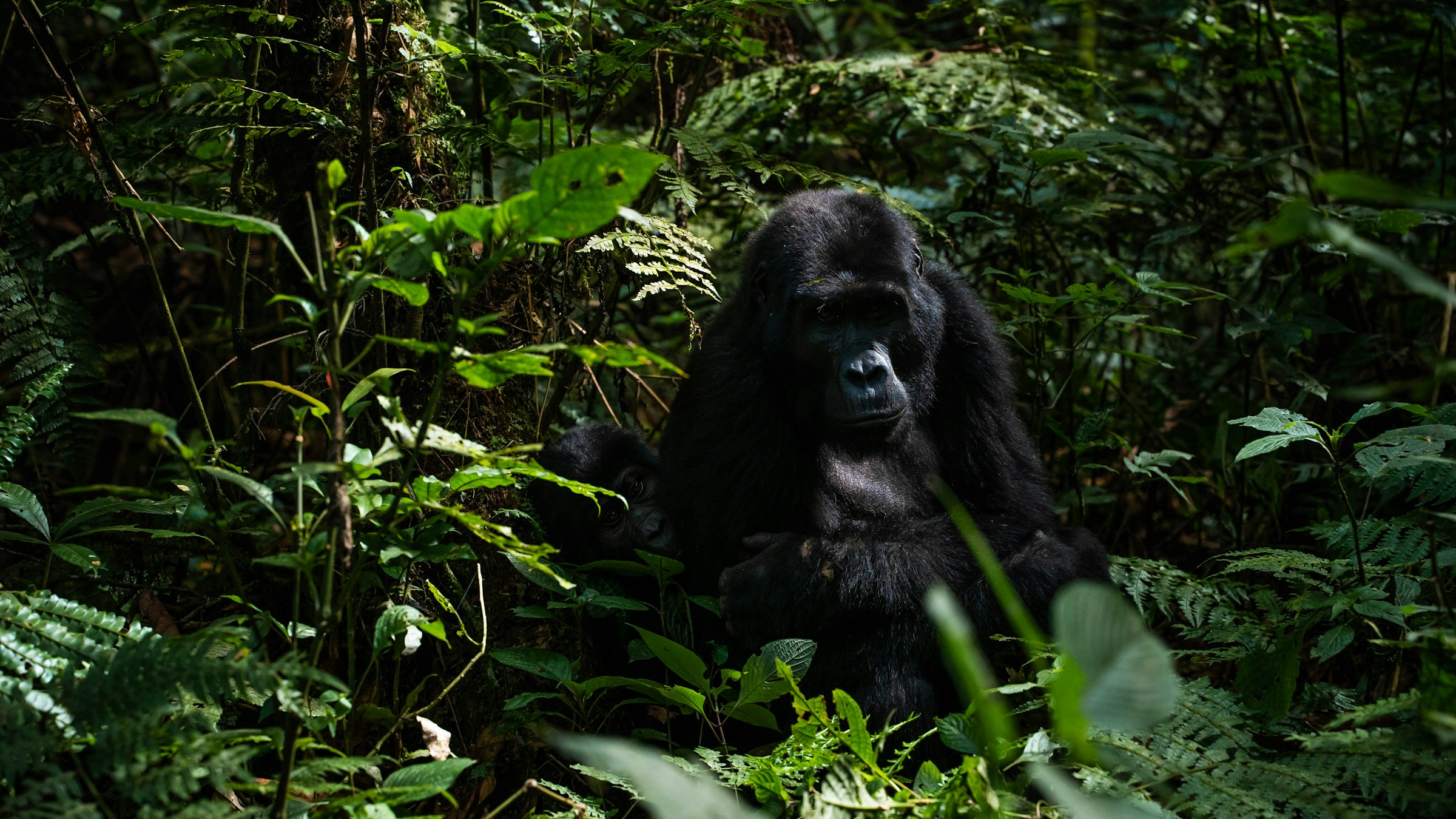
Bwindi Impenetrable Forest is exactly what its name promises: a dense, ancient rainforest of tangled undergrowth, steep ridges, and narrow, muddy trails. Treks can run 1 to 6 hours each way, and the effort is real. The forest is darker and wetter, which makes for a wilder feel but harder photography.
Volcanoes National Park climbs the slopes of the Virunga volcanoes through bamboo forest, Hagenia woodland, and open meadows. The main challenge here is altitude rather than terrain, and the more open landscape makes for easier walking and clearer photos. Most trekkers find Volcanoes the more manageable of the two.
In both parks, the length of the hike is unpredictable, because you follow the gorillas to wherever they moved overnight. A porter for $10 to $20 is worthwhile in either park.
Gorilla families and availability
Bwindi has a clear edge on numbers. It holds more than 20 habituated families across its four sectors, Buhoma, Ruhija, Rushaga, and Nkuringo, giving it more permits per day and more variety of trekking experiences. Volcanoes has around a dozen habituated families. In practice, more families means Bwindi permits can be marginally easier to secure in peak season, though both parks sell out for popular dates and should be booked three to six months ahead.
Access: Volcanoes’ decisive advantage
This is where Volcanoes pulls firmly ahead. The park sits about 2.5 hours by paved road from Kigali International Airport. You can land in the evening and be with gorillas the next morning, with no domestic flights or long overland travel.
Bwindi is far more remote. From Entebbe International Airport it is an 8-to-10-hour drive, usually split over two days, or a scheduled domestic flight to the Kihihi or Kisoro airstrip followed by a 1-to-2-hour transfer. The journey is scenic, but it costs you time. For travelers with only a few days, Volcanoes’ accessibility can decide the matter on its own.
Scenery, altitude, and setting
Both parks are beautiful in different registers. Volcanoes is dramatic and open, framed by the cones of the Virunga volcanoes, with golden monkeys, the Dian Fossey tomb hike, and Lake Kivu all within easy reach. Its trailheads sit high, so altitude is a genuine factor.
Bwindi is one of Africa’s oldest and most biodiverse rainforests, a UNESCO World Heritage Site alive with birds, butterflies, and other primates. Its lower, denser forest feels more enclosed and untamed. If your image of gorilla trekking is thick, misty jungle, Bwindi delivers it; if it is volcanic peaks and open ridges, Volcanoes is your park.
What a full trip costs in each park
Add lodging, private transport, guiding, and transfers to the permit, and a complete guided gorilla safari typically runs:
- Volcanoes (Rwanda): roughly $3,000 to $7,000+ per person, depending on length and lodge level. Our 3 Days Rwanda Gorilla Trekking Safari is the most popular short option.
- Bwindi (Uganda): commonly 15 to 30 percent less for a comparable trip, thanks to the lower permit and lodge costs, though the longer travel may add a night. See our 4 Days Gorilla Tracking Safari in Uganda.
So which park should you choose?
Here is the honest conclusion we give travelers who ask.
Choose Volcanoes National Park if you have limited vacation days, you want to fly in and trek the next morning, you prefer an easier hike and clearer photography, or you are pairing the trek with a luxury lodge. The higher permit buys you time and comfort.
Choose Bwindi Impenetrable Forest if budget matters, you want more gorilla families and sectors to choose from, you are drawn to a tougher rainforest trek, or you want the four-hour habituation experience.
Choose both if you can spare 8 to 10 days. The parks lie within driving distance across the border, covered by one East Africa Tourist Visa (around $100), so a combined trip lets you trek different families in each and judge the two for yourself. For the wider country-level comparison beyond just the parks, read our Rwanda vs Uganda gorilla trekking guide.
“Travelers ask me to pick a winner between Bwindi and Volcanoes, and I always turn it around,” says Reginal Hakizimana, founder of Rwanda Eco Company and Safaris. “Volcanoes is the one you choose with your calendar, when time and comfort matter most. Bwindi is the one you choose with your heart, when you want the deep forest and do not mind working for it. There is no wrong park here, only the right one for your trip.”
Booking with a specialist who knows both parks
Permits in both parks are limited, non-refundable once issued, and best secured through a licensed operator. Rwanda Eco Company and Safaris, founded by Reginal Hakizimana and guiding gorilla treks since 2008, arranges treks in Volcanoes, Bwindi, and across the border in a single trip. We are members of the Rwanda Tours and Travel Association (RTTA), ASTA, ATTA, and USTOA, and hold a 5.0/5 rating across 238 TripAdvisor reviews.
Ready to plan? Browse our gorilla safaris or contact our team for a tailored quote and current permit availability in both parks.
Frequently Asked Questions
Is Bwindi or Volcanoes National Park better for gorilla trekking? +
Both protect the same wild mountain gorillas, so neither is objectively better. Volcanoes National Park in Rwanda is better for travelers who want easy access, comfort, and a shorter trip, since it is only 2.5 hours from Kigali airport. Bwindi Impenetrable Forest in Uganda is better for travelers who want a lower price ($800 versus $1,500), more gorilla families to choose from, and a wilder rainforest adventure.
How much do gorilla permits cost in Bwindi versus Volcanoes? +
A gorilla permit in Bwindi (Uganda) costs $800 per person, while a permit in Volcanoes National Park (Rwanda) costs $1,500 per person, a difference of $700. Bwindi's Rushaga sector also offers a four-hour gorilla habituation experience for $1,500, which Volcanoes does not offer at all.
Which park is harder to trek, Bwindi or Volcanoes? +
Bwindi is generally the harder trek. Its dense rainforest, steep ridges, and muddy trails demand more effort, and hikes can last 1 to 6 hours each way. Volcanoes National Park is more manageable for most trekkers, climbing volcanic slopes through bamboo and open meadows, where altitude is more of a challenge than the terrain itself.
Which park has more gorilla families? +
Bwindi has far more. It holds more than 20 habituated gorilla families across four sectors (Buhoma, Ruhija, Rushaga, and Nkuringo), while Volcanoes National Park has around a dozen habituated families. More families in Bwindi can make peak-season permits slightly easier to secure, though both parks sell out for popular dates.
Which gorilla park is easier to reach? +
Volcanoes National Park is much easier to reach. It is a 2.5-hour drive on paved road from Kigali International Airport, so you can fly in and trek the next morning. Bwindi is an 8-to-10-hour drive from Entebbe, or a domestic flight to the Kihihi or Kisoro airstrip followed by a road transfer. Access is Volcanoes' single biggest advantage.
Can you visit both Bwindi and Volcanoes on one trip? +
Yes. The two parks are within driving distance across the Rwanda and Uganda border, and a single East Africa Tourist Visa (around $100) covers both countries. A combined itinerary of 8 to 10 days lets you trek gorilla families in each park and compare the two experiences directly.
Which park is better for photography? +
Volcanoes National Park is generally better for photography. Its more open bamboo forest and meadows let in more light, making it easier to get clear shots. Bwindi's dense, dark rainforest canopy can make photography more challenging, though it rewards you with a wilder, more atmospheric setting.
Updated July 7, 2026