
Rwanda
1 Day
1 Day Akagera National Park Game Drive
From
$300 /person
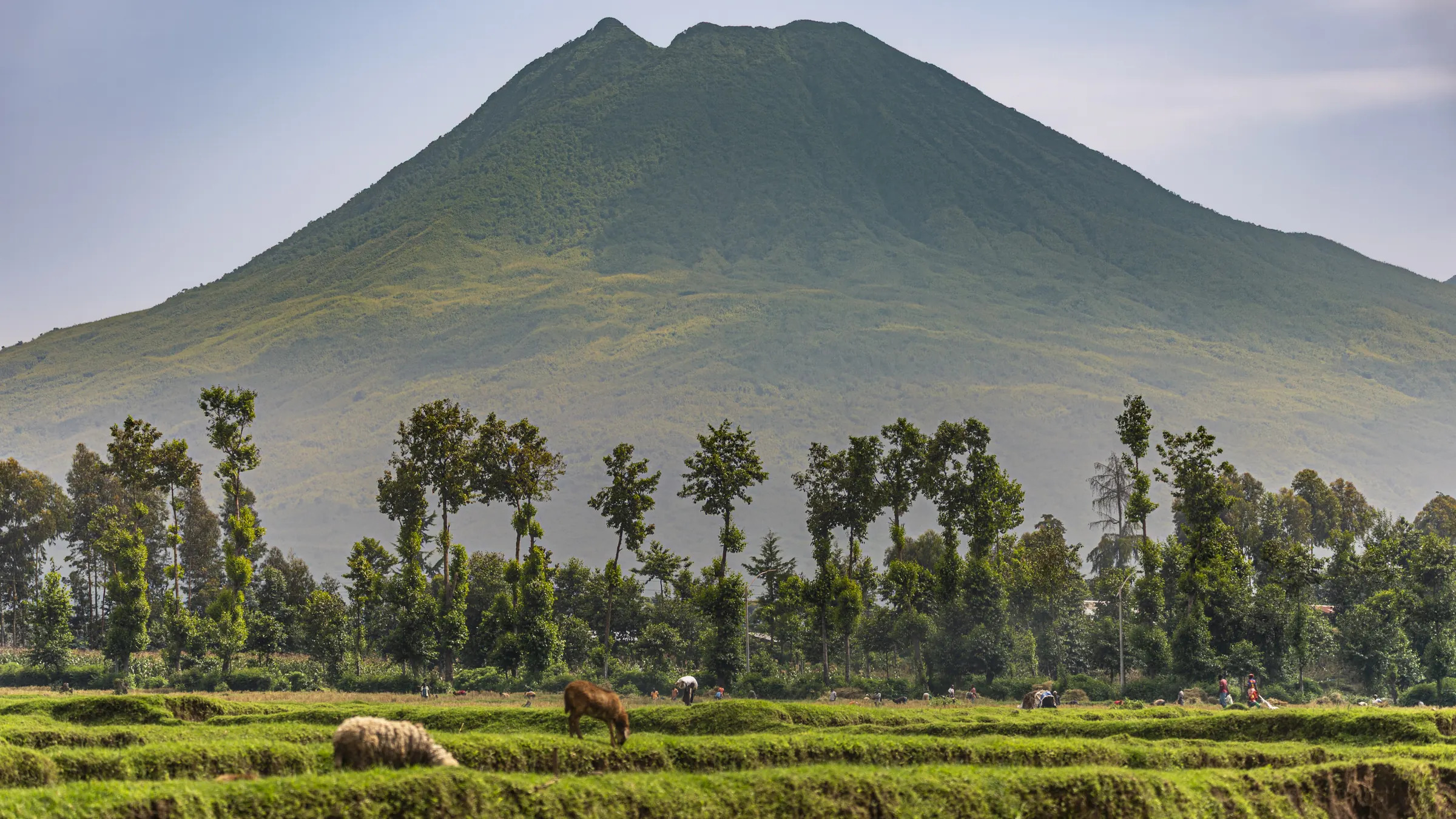
Volcanoes National Park is a 160-square-kilometer protected area in northwestern Rwanda, about 2.5 hours by road from Kigali, and the only place in the country to trek mountain gorillas. It covers the Rwandan side of the Virunga Massif, home to 604 of the world’s 1,063 mountain gorillas, and holds 12 habituated gorilla families open to visitors. A gorilla trekking permit costs $1,500 per person from the Rwanda Development Board (RDB), and only 96 permits are issued per day. The park also offers golden monkey trekking ($100), day hikes up Mount Bisoke and to Dian Fossey’s tomb ($75 each), and a two-day climb of Mount Karisimbi ($400). Rwanda Eco Company and Safaris, based in Kigali, runs private trips here every week of the year.
| Location | Musanze District, northwestern Rwanda |
| Size | 160 square kilometers |
| Established | 1925, the first national park in Africa |
| Altitude | 2,400 to 4,507 meters |
| Headquarters | Kinigi, 15 minutes from Musanze town |
| From Kigali | About 2.5 hours by paved road, 25 minutes by helicopter |
| Gorilla families open to visitors | 12 |
| Gorilla permits per day | 96 (8 visitors per family) |
| Managed by | Rwanda Development Board |
There is no gate fee. Every activity has its own RDB permit, and the price is the same whichever operator you book through.
| Activity | Permit (per person) | Time needed |
|---|---|---|
| Mountain gorilla trekking | $1,500 | 2 to 8 hours, 1 hour with the gorillas |
| Golden monkey trekking | $100 | 2 to 3 hours |
| Mount Bisoke crater lake hike | $75 | About 6 hours round trip |
| Dian Fossey tomb hike | $75 | 3 to 4 hours round trip |
| Mount Karisimbi climb | $400 | 2 days, 1 night camping |
| Musanze Caves | $50 | 1.5 hours |
Permit fees are set by RDB and can change; we confirm the current rate when we hold your dates. For what a full trip costs once lodging and transport are added, see our Rwanda gorilla trekking cost guide.
Gorilla trekking is why nearly everyone comes. Each morning at 7:00 am, permit holders gather at the Kinigi headquarters for coffee, a briefing, and assignment to one of the 12 habituated families in groups of no more than eight. Rangers match groups to fitness: some families stay close to the park wall and can be reached in 30 minutes, others range high on Karisimbi or Bisoke and take three hours or more each way.
Once the trackers find the family, you spend exactly one hour with them at a distance of about 10 meters. Silverbacks, mothers, and infants carry on feeding and playing; the habituation process, which takes two to three years, only means they no longer flee from people.
Three rules shape the planning:
For an hour-by-hour account of the morning, read what to expect on gorilla trek day, and use our gorilla trekking packing list before you close your bag.
“People worry about the hike and forget to plan the afternoon before. Arrive at your lodge by 3:00 pm, eat early, and sleep. The guests who do that enjoy every minute of the trek,” says Reginal Hakizimana, founder of Rwanda Eco Company and Safaris.
Five of the eight Virunga volcanoes rise inside the park. All are dormant or extinct; the two active Virunga volcanoes, Nyiragongo and Nyamuragira, are across the border in Congo.
| Volcano | Height | What to know |
|---|---|---|
| Karisimbi | 4,507 m | Highest point in Rwanda. Two-day climb with a night at 3,700 meters. |
| Muhabura | 4,127 m | Steep one-day climb on the Uganda border, small crater lake at the top. |
| Bisoke | 3,711 m | The most popular day hike, with a 400-meter-wide crater lake at the summit. |
| Sabyinyo | 3,669 m | The jagged “old man’s teeth.” The summit marks the meeting point of Rwanda, Uganda, and Congo. |
| Gahinga | 3,474 m | The smallest of the five, with a swamp-filled crater and bamboo forest. |
The vegetation changes with height: farmland to the park wall, then bamboo (2,400 to 2,800 meters), Hagenia and Hypericum woodland (to 3,300 meters), giant lobelia and senecio, and bare alpine ground on the highest summits. For more on each peak, see our guide to the five volcanoes in Rwanda.
Golden monkey trekking. Golden monkeys live only in the Virunga bamboo forests. Two habituated troops of 80 to 100 animals are visited each morning, the walk is short and nearly flat, and there is no limit of eight people, so permits are easy to get. It is the natural second-day activity.
Dian Fossey tomb hike. A 30-minute drive from Kinigi and a climb of about 1.5 hours to roughly 3,000 meters brings you to the ruins of the Karisoke Research Center, which Fossey founded in 1967, and to her grave beside the gorillas she studied.
Ellen DeGeneres Campus. The Dian Fossey Gorilla Fund’s research and visitor center in Kinigi opened in 2022. Entry is free, and an hour here before your trek makes the trek itself richer. See our visitor notes on the campus.
Culture and lakes. The Gorilla Guardians Village, run by former poachers and their families, the lava-tube Musanze Caves, and the twin lakes of Burera and Ruhondo all fit into a free afternoon.
Kwita Izina. Each September, Rwanda names the gorilla infants born in the past year at a public ceremony in Kinigi. Lodges fill months ahead for that week.
The park is open all year and gorillas are seen on more than 98 percent of treks in every month. What changes is the trail.
Daytime temperatures at Kinigi sit between 15 and 22°C (59 to 72°F) year-round, and mornings can be 10°C (50°F). Rain is possible on any day, in any month. Our best time for gorilla trekking in Rwanda guide breaks this down month by month.
Volcanoes National Park is the most accessible gorilla park in Africa. From Kigali International Airport, the drive to Kinigi takes about 2.5 hours on a good paved road through Rwanda’s terraced hills. A helicopter transfer takes 25 minutes. You can land in Kigali in the afternoon and be with gorillas the next morning.
All Rwanda Eco Company safaris include a private 4x4 and driver-guide from Kigali. From the park, it is 1.5 hours on to Lake Kivu at Gisenyi, and about 4 hours across the border to the southern sectors of Bwindi Impenetrable Forest for travelers who want to trek in both countries.
Lodges cluster around Kinigi, within 10 to 30 minutes of the park headquarters.
| Tier | Lodges | Typical rate (per person, per night) |
|---|---|---|
| Ultra-luxury | Bisate Lodge, Singita Kwitonda Lodge, One&Only Gorilla’s Nest, Sabyinyo Silverback Lodge | $1,500 to $3,000, fully inclusive |
| Mid-range | Mountain Gorilla View Lodge, Five Volcanoes Boutique Hotel | $200 to $500 |
| Budget | Tiloreza Volcanoes Eco Lodge, Virunga Inn Resort & Spa, guesthouses in Musanze | $60 to $150 |
The lodge tier, not the trek, is what separates a $3,000 trip from a $12,000 one. Our luxury Rwanda safari guide covers the top end in detail.
These are the itineraries our guests book most often. Every one includes the gorilla permit, private transport from Kigali, lodging, and meals.
To compare every option by length and budget, start with our Rwanda safari packages guide.
Volcanoes National Park was gazetted in 1925 to protect gorillas from hunters, and it is where Dian Fossey spent 18 years documenting them. The high permit price is deliberate: it keeps visitor numbers low while funding rangers, trackers, and veterinarians. Ten percent of all park tourism revenue goes to the communities around the park through RDB’s revenue-sharing program, paying for schools, clinics, and water tanks. The result is one of the few conservation successes among great apes. The mountain gorilla population has grown from about 620 in 1989 to 1,063, and in 2018 the IUCN moved the subspecies from Critically Endangered to Endangered. Rwanda is now expanding the park by about 23 percent to give the growing families more room.
Volcanoes National Park is in northwestern Rwanda, on the border with Uganda and the Democratic Republic of Congo. The park headquarters is at Kinigi, about 15 minutes from the town of Musanze and roughly 2.5 hours by paved road from Kigali International Airport.
There is no general entry ticket. You pay per activity to the Rwanda Development Board: $1,500 for a gorilla trekking permit, $100 for golden monkey trekking, $75 for the Mount Bisoke day hike, $75 for the Dian Fossey tomb hike, and $400 for the two-day Mount Karisimbi climb. A complete 3-day gorilla safari from Kigali with Rwanda Eco Company starts at $3,022 per person.
Five of the eight Virunga volcanoes stand in the park: Karisimbi (4,507 meters, the highest point in Rwanda), Muhabura (4,127 meters), Bisoke (3,711 meters), Sabyinyo (3,669 meters), and Gahinga (3,474 meters). All five are dormant or extinct.
The Virunga Massif, which Volcanoes National Park shares with Mgahinga in Uganda and Virunga National Park in Congo, held 604 mountain gorillas at the last census, more than half of the 1,063 left in the wild. Twelve habituated families on the Rwandan side are open to visitors, each seen by a single group of eight people per day.
June to September and December to February are the dry seasons, with firmer trails and the highest demand for permits. March to May and October to November are wetter and muddier, but the gorillas are often found lower on the slopes, treks can be shorter, and lodges discount their rates.
Two nights is the minimum for a comfortable gorilla trek: arrive the afternoon before, trek the next morning, leave the day after. Three nights adds golden monkeys or the Dian Fossey hike. A same-day trek from Kigali is possible with a 4:00 am departure.
The minimum age for gorilla trekking is 15, set by the Rwanda Development Board with no exceptions. Younger children can visit the Ellen DeGeneres Campus of the Dian Fossey Gorilla Fund, the Gorilla Guardians Village, the Musanze Caves, and the twin lakes while the adults trek.
Updated November 10, 2026
From
$300 /person

From
$1,854 /person

From
$205 /person
Get in Touch
Talk to our experts about building a trip tailored to your travel dates, budget, and must-have experiences.